
Sleep And Mood In The Research Record
17 November 2015·Sleep and Mood
Few relationships in psychology are as easy to reproduce as the one between disturbed sleep and low mood. It appears in questionnaires, in diary studies, in laboratory work and in clinical description, across very different populations. What that consistency does not settle is what causes what.
A night has structure
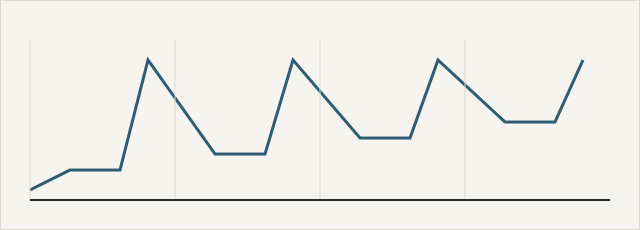
Sleep is not a uniform block of inactivity. Recordings taken through a night show repeating cycles that move between lighter stages, deeper slow-wave stages and the stage in which rapid eye movements and vivid dreaming occur. The mixture is not even across the night: deeper stages dominate the early cycles, while the later ones carry proportionally more of the rapid-eye-movement stage. Waking early therefore removes a different part of the night than going to bed late does.
This is one reason total hours is a crude measure. Two people reporting the same duration may have had very different nights, and self-reported duration and recorded duration frequently disagree.
The direction problem
Cross-sectional studies cannot separate the possibilities, because a person who sleeps badly and reports low mood is compatible with sleep affecting mood, mood affecting sleep, and a third factor affecting both. Longitudinal designs help a little by establishing which came first in time. Experimental restriction studies, in which volunteers have their sleep shortened under controlled conditions, help more, and they generally find measurable shifts in emotional reactivity and in the ability to sustain attention.
Even those designs have limits. Volunteers know they are being kept short, restriction is brief compared with the chronic patterns the observational literature describes, and mood measures rely on self-report from people who are aware of the manipulation.
What the honest summary looks like
The defensible statement is that the relationship is bidirectional, well established in association, and only partly understood as a mechanism. Popular accounts tend to collapse this into a single arrow and a target number of hours. The literature supports neither the arrow nor the number as a general rule, and a fair reading has to hold the association and the uncertainty at the same time.
Permalink: /notes/sleep-and-mood-in-the-research-record